One of our recent on-premise Admiral customers told us something we hear a lot: Admiral…
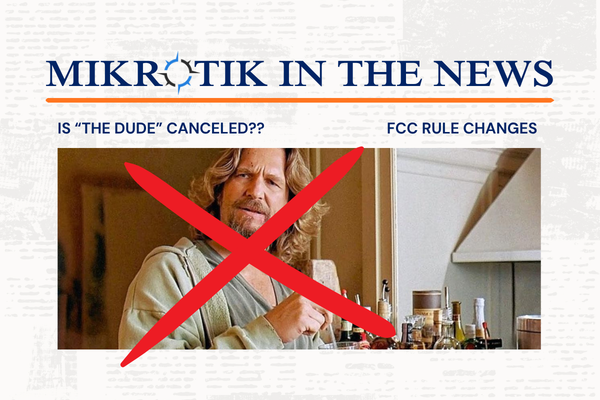
FCC Prohibits Foreign Routers, MikroTik dumps Dude
We’ve gotten a lot of questions this week about the FCC announcement and MikroTik’s update on The Dude, so we wanted to share our take on both.
FCC update on foreign-made consumer-grade routers
This week, the FCC announced that it has updated its Covered List to include foreign-made consumer-grade routers. In practical terms, that means new models in that category cannot receive new FCC equipment authorization, which generally means they cannot be newly imported, marketed, or sold in the United States. The FCC also made clear that this action does not apply to previously authorized models and does not affect routers that consumers or businesses have already purchased and deployed.
What this means right now
For most network operators, there is no reason to panic.
If you already have MikroTik gear, TP-Link gear, or other previously approved equipment in production, this announcement does not mean you need to rip and replace anything. Existing, lawfully purchased and FCC approved devices can continue to be used, and previously authorized device models can continue to be sold and imported.
Where this may matter is with future hardware releases. If a manufacturer wants to bring a brand-new model into the U.S. market and that device falls into the FCC’s covered category, that model could face a real approval hurdle!
Our view on MikroTik
In our opinion, MikroTik is not a simple “consumer router” brand in the way most people think of home networking products.
Even MikroTik’s smaller platforms are often used in business, ISP, WISP, MSP, and infrastructure environments. Many MikroTik products support advanced routing and service-provider-grade features that go far beyond typical home networking use cases. That does not automatically mean MikroTik is exempt from future scrutiny, but it does suggest there is still room for interpretation around how particular products may be categorized in practice.
So for now, our view is straightforward: keep buying and deploying currently authorized MikroTik models as normal. The bigger question is what happens to future, brand-new models, especially as new Wi-Fi generations roll out.
What happens next?
The FCC’s current action is focused on new device models. That means the immediate impact is more about the future product pipeline than the installed base. The FCC also notes that producers of consumer-grade routers may continue receiving authorizations if they obtain conditional approval from the relevant agencies.
So the main issue to watch is not whether your current routers suddenly become unusable. They do not. The real issue is whether future products will be approved for the U.S. market, delayed, waived, reclassified, or redesigned for compliance.
The key FCC language
The FCC summarized the impact this way:
- New devices on the Covered List, such as foreign-made consumer-grade routers, cannot receive FCC authorization and therefore cannot be newly imported for use or sale in the U.S.
- Previously authorized device models are not affected.
- Previously purchased routers are not affected.
- Conditional approval remains possible in some cases.
MikroTik The Dude is now officially legacy
Separately, MikroTik updated its official documentation for The Dude on March 25, 2026, stating that development has been officially discontinued. MikroTik says the software is now classified as legacy, provided on an as-is basis, and that no further updates or enhancements are planned for the foreseeable future.
That is disappointing news.
The Dude has been an important tool for network monitoring and management for years, and many operators around the world still rely on it. We also know a number of Admiral customers use both Admiral Platform and The Dude today.
The good news is that mature software does not suddenly stop working just because it becomes legacy. In many environments, The Dude may continue serving its purpose for quite a while. But the announcement is still significant because it means users should not expect ongoing development, new features, or long-term modernization from MikroTik.
Our take on what comes next
At Admiral, we see this as an opportunity and a responsibility.
Network operators still need centralized visibility, mapping, alerting, dashboards, and monitoring across MikroTik and other SNMP-capable infrastructure. If The Dude is no longer being actively developed, then the market will increasingly need a modern, fully supported alternative.
That is exactly how we see Admiral Platform’s role: helping fill that gap with a supported, centralized RMM platform built for real-world operators who still need strong monitoring, visibility, and operational control.

Related Posts